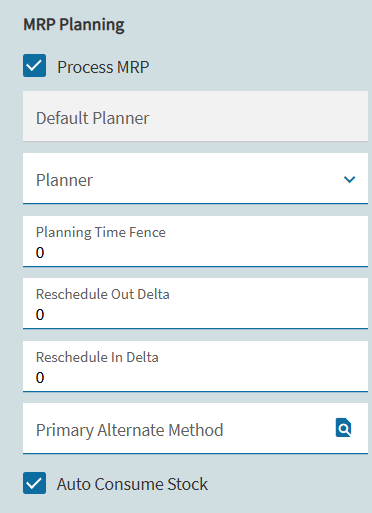
Thanks David, this is probably going to be strictly notational just so someone who is quoting could pull/review the alt method.
So MRP isn’t really needed for these methods, we aren’t trying to plan by these.
Thanks David, this is probably going to be strictly notational just so someone who is quoting could pull/review the alt method.
So MRP isn’t really needed for these methods, we aren’t trying to plan by these.
You are correct. MRP only sees the Parent Revision.
THEORETICALLY, if the Parent Revision is in a different Site and the Alt Method is in the MRP site, the Alt Method will be used. I have not tested this.
Thank you for all of your information today, this has been very helpful!
Regarding the MRP and Alt Method…what we plan on doing is if we have a machine go down and know we’ll be using the Alt Method for awhile, we were going to pick the Alt Method in the MRP Planning section on the site tab. Now, any existing job would be built to the Parent method since the job was created. But any new job that has an alt method specified here, would be built as the alt method. That was my assumption…I can’t forget what we found in our testing, but I hope that’s the case.
 This
This
Not this  (Sorry @Ernie, I don’t think I’ve ever seen it do this automatically.)
We use alt methods a lot. It’s VERY fragile. I have a few BAQs that our Engineers monitor to ensure that it’s all set up properly. It is very easy to do it wrong.
But yes, “Primary Alternate Method” is the single source of truth for what alt to use (blank IS an alt).
To expand on the difficulty:
Are you’re saying an AltMethod of a Part requires AltMethods for each subassembly, too?
Not precisely.
The subassemblies need data relevant to the site the job is in (i.e. operations, methods/revisions, and parts).
If you have a single site, then mix and match alts at will - you won’t have an issue. (This was us in 2016.)
If you have two sites, where finished goods part FG1:
And if you want a job for FG1 in site B:
That revision can be an alt rev OR a regular revision.
In practice, I’d think it would be odd to have site B use alt methods for the finished goods but not for the subassemblies, but you certainly could.
Don’t be sorry! The truth is the goal. Thanks for correcting me!
Backstory, if anyone cares (I don’t know why you would…):
We used to build one of our main products ourselves. Then we switched to outsourcing it.
For a while we limped along with it in the same site as our main product line. Then we decided to set up a new site (Epicor word) for the outsourced product. Orders, POs, inventory all flow through the new site. And jobs.
Since we still had the baggage of the BOMs in the original site, we had to make a choice:
A. Needlessly increase the rev letter of all relevant BOMs and establish them all in the new site with new operations
B. Maintain dual records - the main rev in the original site and an alt method for every one in the new site
And we chose B.
(We might undo it all one day and bring it back in house. So we didn’t want to burn the bridges. Plus the engineering work of hundreds of Engineering Change Notices saying “Nothing changed! Just a new rev for Epicor.”)
Context. Is. Critical.
Everything starts somewhere. The basic logic of (probably) ALL modern ERP systems STILL mostly comes from the original IBM product of the 1960s. It has certainly evolved through the decades, but having been born there it still has those roots.
Until you know WHY grandma chopped both ends off the ham, you’ll probably keep chopping them off yourself.
My C (programming language) teacher in college made us read whatever the book was from the IBM people that wrote the language. That was our textbook for the semester. (My class was in… 2003?)
I am dying to know about the ham now… Oh, so it fit in the oven, right?
hehehe yup… google it.
“those who do not study history are doomed to repeat it”
Sadly, even if we study it we still tend to repeat it.