I’m trying to understand how Epicor MRP handles PO Suggestions into the future when using the “Allow Consumption of Minimum Qty” setting.
We want MRP to generate future PO Suggestions that maintain stock levels as expected using “Consume Minimum” and more recommended approach.
Within lead time, the logic works as described: if SOH is between Min and Safety and there’s an open PO, no new suggestion is created
Outside the lead time, however, MRP suggests POs that push stock well above the minimum/expected level. In a non-MRP system, we’d expect stock to fluctuate between Max and Safety, but here it seems to build much higher.
Note, we often have multiple PO’s open, as it is not economical to place 3+ month order qty in one go. If we placed one large order to Max, it may work, but that is not practical for us.
Our understanding of current logic is net SOH + Open PO (within lead time) is less than Min and Safety stock, then suggest an order.
Our expectation would be that we could continue this logic so we can predict future stock. Thus the ongoing calculation would be net SOH + Open PO + suggested POs.
Below is a comparison of timephase with “Allow Min Consumption” off and “Allow Min Consumption” on. Standard (IP&O) minimums were used when Allow Min consumption was on.
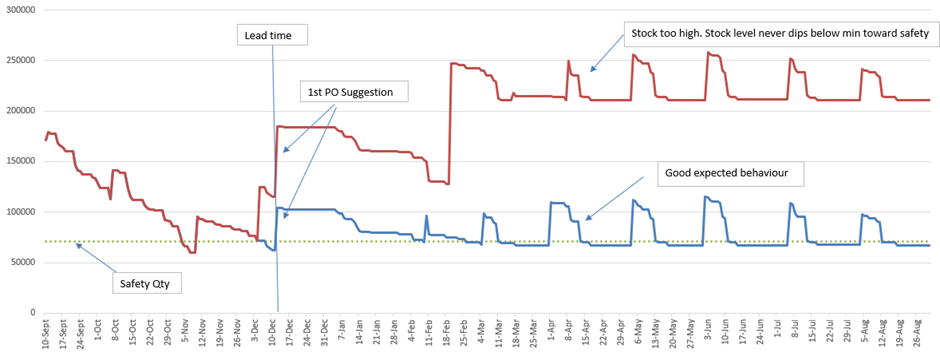
Blue Line (Allow Min Consumption OFF):
- Min: 0 | Max: 0 | Safety: 71,000 | Lead Time: 90 | Days of Supply: 20
- This behaves as expected: suggestions keep stock near the minimum.
Red Line (Allow Min Consumption ON):
- Min: 144,000 | Max: 222,000 | Safety: 71,000 | Lead Time: 90 | Days of Supply: 20
- Based on standard Mins (compared with IP&O). This is where we see overbuilding.
Is this expected behaviour when “Allow Consumption of Minimum Qty” is ON?
If so, how can we configure MRP to avoid excessive future PO suggestions?