I am looking at the result of running the “Calculate Global Scheduling Order”, I was under the understanding that the schedule sequence is based on days late and scheduling code. If this is the case why do some jobs with a greater number of days late appear later in the scheduling order?
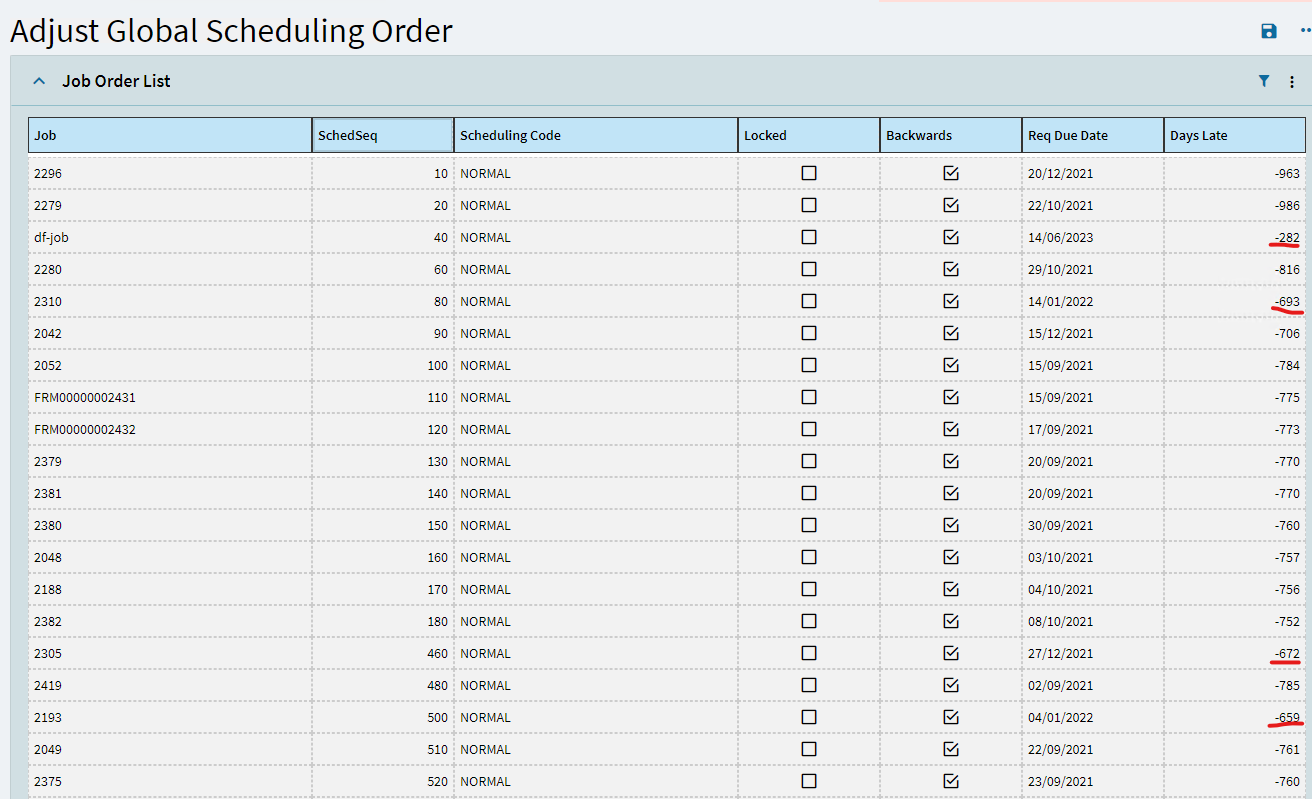
There are too many factors that go into the calculation to be able to answer. I would look at the Scheduling Logs to dig in and try to figure out why. Do you reschedule started operations? If not, that could be one reason why. Are they all running on the same machines? Does one of them have a short operation that can sneak through? Are you infinite or finite?
Even though something might not be that late, the scheduling engine is still going to try and produce the most optimal schedule by dropping in operations if it can.
All of those points are relevant as to the final global schedule, but the sequence calculation is much simpler than that. It’s hard to say what exactly its doing, but the documentation explicitly states it’s forward scheduling with infinite capacity. So it shouldn’t really look at whether or not you can slip a small op in between larger runs until you run the actual global schedule process.
I do know that not cleaning up old or aborted jobs can majorly screw up this part of the process. It might also be looking at demand links to figure out rough order. Do any of these aberrant jobs feed into other jobs?