So far, this is working great! I have one small issue where I want to pull data from the timeclock, where there are no records in Epicor. For example, our Drivers punch in and out, but don’t use Epicor. My BAQ that pulls the data from the API is based on the JCDept and a filter. But the JCDept for drivers, doesn’t exist in Epicor. I have set the two departments that are not in Epicor to 100, and 101. I think I need to switch around my base query to pull based on just the list of JCDepts that I give, but not have it be restricted to only the JCDepts in Epicor. Basically, here is a list of JCDeptIDs. Get the internal Epicor data for them, and the timeclock data. If one or the other doesn’t exist then just show a blank or 0.
Base UBAQ:
select
	[DeptEff].[LaborHed_Company] as [LaborHed_Company],
	[DeptEff].[JCDept1_JCDept] as [JCDept1_JCDept],
	[DeptEff].[JCDept1_Description] as [JCDept1_Description],
	(EarnedHours.Calculated_ProdEH) as [Calculated_DayEH],
	(DeptEff.Calculated_LaborHours) as [Calculated_DayLab],
	(DayEH/ DayLab) as [Calculated_DayProd],
	(0) as [Calculated_TCHrs],
	(@EndDate) as [Calculated_myDate],
	(0) as [Calculated_pulled]
from  (select
	[LaborHed].[Company] as [LaborHed_Company],
	[JCDept1].[Description] as [JCDept1_Description],
	(sum(LaborDtl1.LaborHrs)) as [Calculated_LaborHours],
	[JCDept1].[JCDept] as [JCDept1_JCDept]
from Erp.LaborDtl as LaborDtl1
inner join Erp.LaborHed as LaborHed on
	LaborHed.Company = LaborDtl1.Company
	and LaborHed.LaborHedSeq = LaborDtl1.LaborHedSeq
inner join Erp.EmpBasic as EmpBasic on
	EmpBasic.Company = LaborHed.Company
	and EmpBasic.EmpID = LaborHed.EmployeeNum
inner join Erp.JCDept as JCDept1 on
	LaborDtl1.Company = JCDept1.Company
	and LaborDtl1.JCDept = JCDept1.JCDept
where (LaborDtl1.JCDept in ('11', '12', '15', '16', '2', '3', '4', '5', '8', '9', '100', '101')  and LaborDtl1.PayrollDate >= @StartDate  and LaborDtl1.PayrollDate <= @EndDate)
group by [LaborHed].[Company],
	[JCDept1].[Description],
	[JCDept1].[JCDept])  as DeptEff
inner join  (select
	[JCDept].[Description] as [JCDept_Description],
	(sum(LaborDtl.EarnedHrs)) as [Calculated_ProdEH]
from Erp.LaborDtl as LaborDtl
inner join Erp.JCDept as JCDept on
	LaborDtl.Company = JCDept.Company
	and LaborDtl.JCDept = JCDept.JCDept
where (LaborDtl.PayrollDate >= @StartDate  and LaborDtl.PayrollDate <= @EndDate)
group by [JCDept].[Description])  as EarnedHours on
	DeptEff.JCDept1_Description = EarnedHours.JCDept_Description
order by DeptEff.JCDept1_JCDept Desc
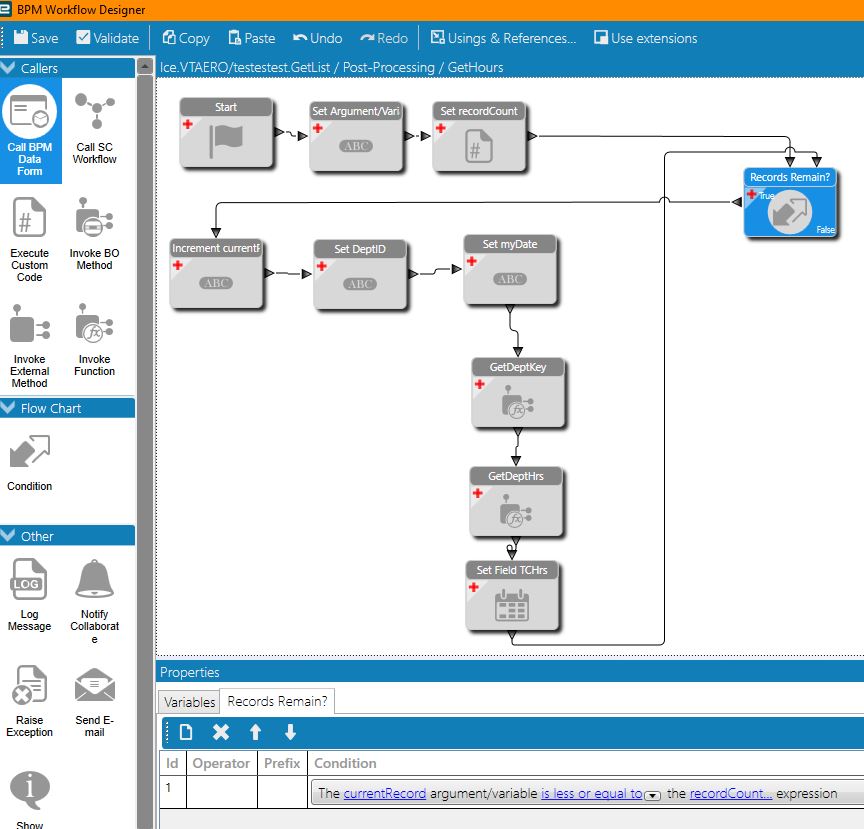
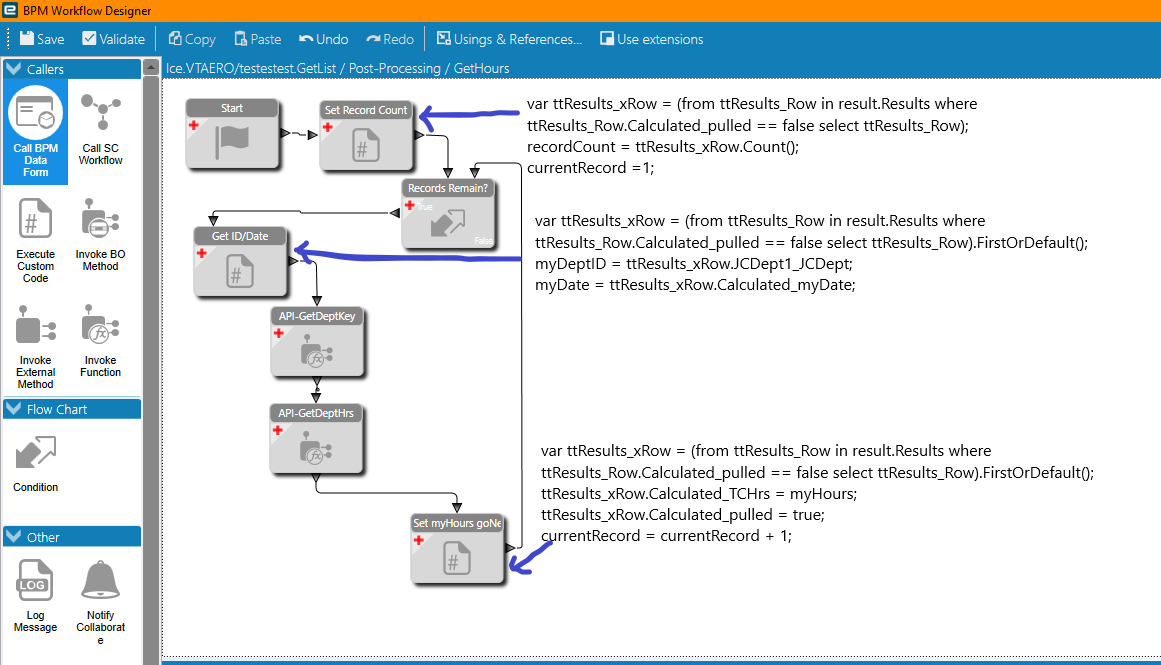
Here is the GetList Method, with my custom Directive GetHours:
And here are my two functions inside the library:
GetDeptKey(in DeptID, out DeptKey):
//use the epicor dept id code to lookup the dept key from asure


 Dictionary<string, string> departmentKeys = new Dictionary<string, string>
            {
                {"9:Quality Control", "791866ff-f69d-4217-b744-3270a06ce846"},
                {"11:Sheet Metal", "9736c126-e903-42fc-b943-6518b62bbec3"},
                {"10:Shipping", "5edc6acb-176a-4f8a-b7b9-6974cb8e9eb4"},
                {"15:Horizontal", "8157cce9-133e-4f0e-917c-b17857e92512"},
                {"8:Burr Bench", "00916604-403f-433a-84eb-c9c9b93dbd76"},
                {"100:Maintenance", "8d94bf71-6734-4990-96c7-da4f41cea9d9"},
                {"4:N.C. Mill", "ffdd73c8-e840-4641-9b9c-e49901c65b33"},
                {"101:Drivers", "7e3000a3-6315-4527-8fab-efad773c0ae5"},
                {"2:Lathe Department", "04e6a140-12f1-4a92-aab5-f625737a5cc2"},
                {"5:Bridgeport", "9c230560-724e-40e1-8ebd-fa970b9eb00d"}
            };

            foreach (var department in departmentKeys)
            {
                var deptIDName = department.Key;
                var deptKey = department.Value;

                // Split the input data based on ":"
                string[] parts = deptIDName.Split(':');

                // Extract department code and name
                var deptCode = parts[0];
                if (DeptID == deptCode)
                {
                  DeptKey = deptKey;
                }
            }
GetDeptHrs(in deptKey, in myDate, out deptHours):
try
{
    // Base URL for the API
    var URL = "MYURL";

    // Initialize RestClient
    var client = new RestClient(URL);

    // Parse myDate to match the expected format for the API call
    if (!DateTime.TryParseExact(myDate.ToString(), "M/d/yyyy h:mm:ss tt", null, System.Globalization.DateTimeStyles.None, out DateTime dateTimeValue))
    {
        // Debug message for invalid date format
        myDebugMsg += "[ERROR] Invalid date format";
        return; // Exit the try block as date parsing failed
    }
    string formattedDate = dateTimeValue.ToString("yyyy-MM-dd");

    // Debug message for formatted date
    myDebugMsg += "Formatted Date: " + formattedDate + " | ";

    // Construct the API request URL
    var myRequest = "webapi/timecards/level/" + deptKey + "/payrolldata/" + formattedDate;
    myDebugMsg += myRequest;

    // Create a RestRequest with the constructed URL and GET method
    var request = new RestRequest(myRequest, Method.GET);

    // Add authorization header
    request.AddHeader("Authorization", "Basic MYAUTHSTRING");

    // Execute the request
    IRestResponse myIResponse = client.Execute(request);

    // Check if request was successful
    if (myIResponse.StatusCode != System.Net.HttpStatusCode.OK)
    {
        // Debug message for failed API request
        myDebugMsg += "[ERROR] API request failed: " + myIResponse.ErrorMessage + " | ";
        return; // Exit the try block as API request failed
    }

    // Extract response content
    string responseData = myIResponse.Content;

    // Debug message for successful API response
    myDebugMsg += "API Response: " + responseData + " | ";

    // Parse the response data into a JSON array
    JArray jsonData;
    try
    {
        jsonData = JArray.Parse(responseData);
    }
    catch (Newtonsoft.Json.JsonReaderException ex)
    {
        // Debug message for JSON parsing error
        myDebugMsg += "[ERROR] JSON parsing error: " + ex.Message + " | ";
        return; // Exit the try block as JSON parsing failed
    }

    // Calculate the total hours for selected PayTypeIDs
    int totalMinutes = 0;

    List<string> excludedPayTypeIDs = new List<string> { "JURY", "HOL", "BER", "SICK/VACA" };

    foreach (JObject record in jsonData)
    {
        // Extract report date and hours
        string reportDate = DateTime.Parse(((string)record["ReportDate"]).Split('T')[0]).ToString("yyyy-MM-dd");
        if (reportDate == formattedDate)
        {
            string payTypeId = record["PayTypeId"].ToString();
            int minutes = Convert.ToInt32(record["Minutes"]);

            if (!excludedPayTypeIDs.Contains(payTypeId))
            {
                totalMinutes += minutes;
            }
            else
            {
                totalMinutes -= minutes;
            }
        }
    }

    // Calculate department hours
    deptHrs = ((decimal)totalMinutes / 60);

}
catch (Exception ex)
{
    // Debug message for other exceptions
    myDebugMsg += "[ERROR] Exception: " + ex.Message + " | ";
}
How can I base my initial UBAQ on the dept IDs that I care about?
Does this make sense? I know it is a deep rabbit hole… Thanks for taking the time to look!
Nate