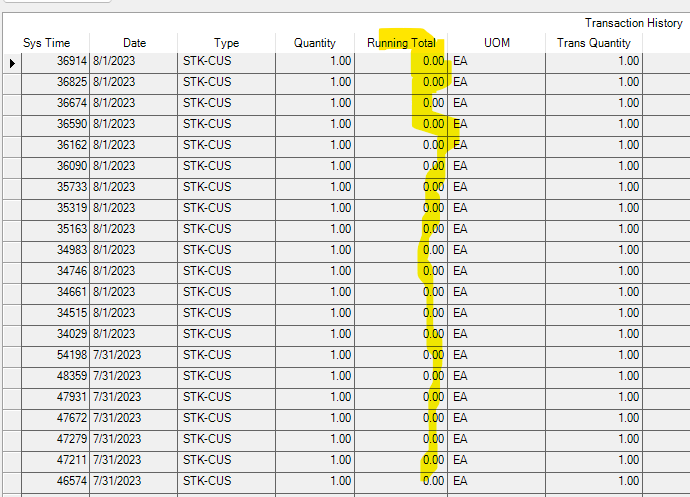
Part# 477 is setup as Non-Stock. We purchased 24 pieces and received them in as PUR-UKN (excuse the typo for unknown). In PARTRAN, I see transactions ADJ-CST (Cost Rollups) from Implementation of Epicor (4/2019) until recently when 3 shipments are transacted as shown.
I do not see how the inventory was managed by Epicor. Shouldn’t the inventory have gone negative as a result of the shipments? Shouldn’t the shipment have generated an error about the non-stock part? Can someone please elaborate on what happens (or should happen) when non-stock parts are trying to ship / invoice? Thanks Tony
ok. if that field is False (not checked) epicor will not track any material transactions you make. Cost will still move based on the STD cost of the part.
There aren’t inventory transactions done for non stock items as there is never a quantity on hand… It can’t have a negative on hand. Below is a part tran history of our for an item we have marked as non-stock.
Ok. So a non-stock part can be shipped. Inventory is unaffected. The sale is made and costs are realized. I see demand is showing in PARTWHSE. Does that matter? Can a part be non-stock and quantity bearing? What would that actually mean?
Are there advantages to making a part non-stock? We have labels for our products with unit cost under 20 cents. We track them in inventory and they are part of a sales kit. Without the need to track the label, there would be no need for the sales kit. We could sell the main part and label as separate line items. Please provide your thoughts…
yes a part can be non-stock and quantity bearing.
Non-stock is telling the system that you want supply to come from a Job or a PO, never from stock inventory.
The “Non Stock” setting on the Part Master is for use with Make-To-Order parts. This refers to parts that are NOT (normally) part of your inventory, but are only manufactured or purchased when a sales order is created for them. This means that if you DO have some lying on the shelf, the MRP process will ignore them and create a Job or PO Suggestion for you to manufacture or purchase them in the correct quantity to fulfill the order.
This is NOT the same as the “Quantity Bearing” setting, which is used for items that are typically expensed directly at purchase and are not counted during a cycle count or physical inventory (like labels, packaging, paper towels, etc.)
Can you elaborate a bit more on the Non-Stock + Quantity Bearing? I understand the MTO you explained; and that no inventory is recorded for non-stock. How does the Quantity Bearing work for the transactions? Is inventory tracked or does the non-stock setting nullify that? Would a PO be received the same way for Non-Stock + Quantity Bearing as it was for just Non-Stock? Thanks Tony
“Non Stock” and “Quantity Bearing” are not related in any way. They are two entirely separate functions.
Let’s go back to the beginning. Is this a make-to-order (or buy-to-order) part that we’re talking about? Is it only manufactured (or purchased) when you have an order from a customer for it?
Leave Quantity Bearing out of the discussion for a moment. Let’s figure out if Non Stock is appropriate first.
Not trying to beat a dead horse, but there is still some misinformation floating around. Non-Stock only means that you don’t intend to keep the part in stock. It doesn’t prevent you from ordering the part to stock or performing inventory transactions. It doesn’t affect how inventory transactions take place or how quantities are tracked.
The effects you are seeing, that you have asked about in your initial post, are all related to the Quantity Bearing setting being false.
If Quantity Bearing is false, inventory/quantity tracking doesn’t happen at all. You can ship 1 billion parts that are Quantity Bearing = false, and inventory is not affected.
Thanks @Ernie and @JasonMcD for clarifying that they are independent settings.
The part in question is actually an axle being sold as a replacement part for a wheel on our product. It is already part of the wheels we buy and install on our products. Thus, we normally would not buy and/stock these axles since they come with the wheels.
@JasonMcD’s Qty Bearing note was very good. QB = False - PUR-UKN - No tracking of inventory / QB = True - PUR-STK - Track Inventory. In our case, we are QB=False for the part.
It sounds to me like the Non-Stock should not have been checked at all for this part since QB = False.
Thanks everyone. I think this answers the question for now.
Thanks @andrew.johnson. Your definitions of Non-Stock and Quantity Bearing help clear up my questions. @Ernie and @JasonMcD have supplied similar definitions. The part is actually set up correctly and doing what it should. We don’t intend to keep the part in stock because it comes with the wheels we buy for our products. This is a situation where a customer needed to replace just the axle.
One more fly to toss into the ointment… is the costing for this item being handled correctly? The VAST majority of us on this forum are Operations side folks… the Finance side isn’t that well represented and thus their views don’t get aired as often as they maybe should.
Bring cookies or doughnuts, wander over to your controller and describe how these transactions are working for you… see if he/she says, “OK by me” or just starts crying…