tmayfield
May 8, 2025, 6:11pm
1
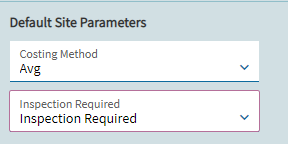
I am trying to write a dashboard if inspection required is set on a part. seems easy enough, there is a drop-down to set the if inspection is required. Yay!
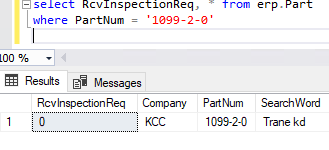
This field is bound to Part.RcvInspectionReqPart. I set that to part 1099-2-0 but when I look in the database this field is a 0.
How do I tell when inspection required is set?
jkane
May 8, 2025, 6:20pm
2
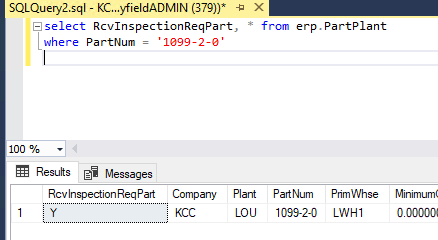
Are you using the partplant table?
bruce6s
May 8, 2025, 6:24pm
3
Try this field, PartPlant_RcvInspectionReqPart
tmayfield
May 8, 2025, 6:58pm
4
Yay, its set there. You would think that if it shows bound to a field it would update that field.
JasonMcD
May 9, 2025, 11:34am
5
Not exactly the same, but I know what you mean:
TL;DR:
Screen
Subsection
Checkbox in UI
Actual DB field
Type
Supplier Price List
Supplier Parts
Primary Supplier
PartPlant.VendorNum
int
Buyer
System Default
XaSyst.SysBuyerID
string
Buyer
Authorized User List
Default Buyer
UserComp.PrimBuyerID
string
Work Force
Authorized User List
DefaultUser
UserComp.PrimSalesRepID
string
Job Entry
Operation > Scheduling Factors
Final Operation
JobAsmbl.FinalOpr
int
Job Entry
Operation > Scheduling Factors
Auto Receive
JobAsmbl.AutoRecOpr
i…
(Wow that is ugly as a preview. It’s a nice chart if you go to the post.)
Anyone know the hierarchy for this?
Here is what I have so far:
Vendor->Local Overrides (PO, etc) → PartPlant.RcvInspectionReqPart(nvarchar(1))->Part.RcvInspectionReqPart(nvarchar(1))->PartClass.RcvInspectionReq(bit)
So basically the partPlant.RcvInspectionReq and Part.RcvInspectionReq are both dead fields now based on my understanding.
Below is what i’m thinking it is but not 100% sure without testing.
1. PO/Receipt Status
2. Vendor QA?
3. PartPlant.Rcv…Part
4. Part.Rcv…Part
5. PartClass.RcvInsp
Expected Outcome
System Rule Validated / Hierarchy Behavior
Force True FalseNNFalsePUR-INS
Manual Escalation: User manually forced inspection on the line, overriding favorable master setup records.
Locked True TrueYYTruePUR-INS
Unified Agreement: Vendor and all underlying inventory tiers demand QA inspection.
Locked True TrueNNFalsePUR-INS
Vendor Dominance: Top-tier vendor flag locks the transaction into inspection, completely ignoring part/site exceptions.
Locked True FalseYYTruePUR-INS
Site & Global Alignment: Local site and global master record rules perfectly match.
Locked True FalseYNFalsePUR-INS
Local Site Mandate: Local facility Y stops evaluation and overrides a global master part set to N.
Locked True FalseY""FalsePUR-INS
Local Site Mandate: Local facility Y forces inspection when the global master part is unconfigured ("").
Available (Blank) FalseNYTruePUR-STK
Site Exemption: Local facility N terminates evaluation early, shielding this warehouse from global part and class constraints.
Available (Blank) FalseN""TruePUR-STK
Site Exemption: Local facility N actively intercepts and overrides baseline PartClass rules.
Available (Blank) FalseNNFalsePUR-STK
Unified Exemption: Every single record explicitly dictates that inspection is not required.
Locked True False""YTruePUR-INS
Global Part Mandate: Site is pass-through (""), so evaluation falls back to global Part Y which aligns with Class.
Locked True False""YFalsePUR-INS
Global Part Mandate: Site is pass-through (""), so evaluation falls back to global Part Y which overrides Class False.
Available (Blank) False""NTruePUR-STK
Global Exemption: Site is pass-through (""), so global Part N intercepts evaluation and breaks baseline Class rules.
Available (Blank) False""NFalsePUR-STK
Global Exemption: Site is pass-through (""), so global Part N aligns with standard baseline Class behavior.
Locked True False""""TruePUR-INS
Class Mandate: Both site and part are pass-through rows; bottom-tier baseline PartClass configuration wins.
Available (Blank) False""""FalsePUR-STK
Standard Flow: Total absence of routing overrides ensures parts flow smoothly straight onto the warehouse floor.
Did anyone ever test any of this to verify/validate?