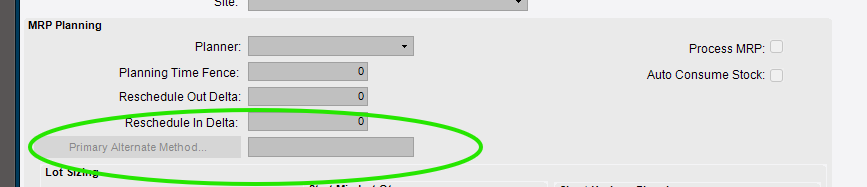
Does anyone have an established workflow for converting part revisions into part rev alternate methods? For example, we have a part with 5 revisions. Three of them are all for rev F, and two are for rev G. All of them are essentially different methods of manufacture. I am about to embark on a process to export all of the part revs, do some excel magic, and reimport them into revs and alternate methods. I have the DMT, and will be using extensively during this process.
I intend to export the part rev, and other associated data. I am not sure what else will be needed just yet.
I am open to any ideas you all may have. Thank you for your time.
Perhaps I need to understand Alternate Revs better. Here is a more complete example of what we are trying to do.
Currently ----
Part - 12345
Revs - X001(A), X002(A), X003(B), X004(C)
Each Rev is a different version and/or different method of manufacture
Alternate Revisions - None
Goal ----
Part - 12345
Revs - A, B, C
Alternate Revs - A (X001, X002)
X001 and X002 are two ways to manufacture the same revision of the part.
B and C only have one rev each so dont need alternates.
From what I have seen in the setup, Rev A will be X001 by default, and if they need X002 on Rev A, then they make an alternate method. Is that right?
Alternate revisions are for companies that have multiple sites. It is for parts that can be made in multiple sites. So, site A is the main site and the operations are 1, 2, 3. Site B is the secondary site where it can be manufactured also, but the operations are 1, 4, 5, 3. I have not really explored it much, but I believe it is used by scheduling to try and give more options to meet demand. If site A is over capacity, but site B is under, the system might suggest the part be made in B since they have capacity.
As far as I know, when using it for other purposes, it is a manual change to the job that needs to be made. That is, for each revision that you want to use the alternate for, someone will need to go into the job, change to the alt, get details, and then release it.
@jkane is correct, that is what the Alternate Rev functionality was designed for, and as far as I know, that is the only way MRP will automatically select an alternate rev during an MRP run. Any other usage of Alternate Revision would involve a manual process.
Which brings the next question… what functionality are you looking for the Alternate Revision to give you?
The UPLOAD via DMT is called “Bill of Operations”, and it (essentially) opens up the Engineering Workbench for each line of the upload.
You’ll also need a Part Revision upload to create your new Revision and Alternate Method records.
The query to get your existing data will need PartOpr and PartOpDtl tables. PartOpDtl contains the Resource/Resource Group/Capability records and is part of the Bill of Operations upload.
Based on conversations with Epicor support and sales, we should be using alternate revisions where we currently make multiple revisions. We have 3 ore more revisions at rev A, each has a different method of manufacture. One might start as a casting, one might start as a raw blank, and one might start as a pre-machined part, they all get a set of operations applied that turn them into the same functional part, a Rev A. Right now this is confusing because our revision is not saved as A, it is saved as an internal code we use to differentiate all the multiple versions of the same revision. (hence X001…).
It seems like alternate revs will work for this if I set it up correctly. Part of my work will be to review each part, all the revs, and decide which need to be pulled into their own rev, and which need to be alternate revs.
If there is a better tool for getting at this, please let me know. This was suggested to us from Epicor.
You can also make MRP use the alternate rev as the default planning by going into part plant and setting it here so that if for some reason the alternate is what you’d like to use for planning purposes (MRP, etc.) it will use that when making the job so you don’t have to switch it around.
I’m interested to see what @Ernie would recommend, but I would not use Alternate Revisions for this. While it would work, it does not seem the correct fit.
I think the most important question we need to know is who makes that decision (casting/blank/pre-machine) and when do they make it. Also, is there a point where all of the operations are the same for all 3 options? If I were to guess, I would think that once all 3 were at a clean part, the operations after that point are the same.
This makes sense to me. Say we started making a part using a casting from the customer. That process worked well for a few years and then they ran out of castings but really needed a few parts. We can hog out a blank to make the same part, but it takes a different set of operations. So we leave the original casting as the main rev, and use the hog out as an alternate rev. More years go by, and the casting house goes under, so we have to hog out all the parts now until they find a new casting house. Now we can set the alternate rev as the default.
When we get the order, we don’t know what material will be used. Sometimes they do know that castings are available, but not always. The engineer works with purchasing to get the correct material ordered. After the parts make it though a few ops, they usually end up on the same course, but not always! This is why we want alternate methods. While the final part might be the same, there could be vast differences in how we get there.
My recommendation would be to make 1 revision wherever the operations line up and then use a subassembly to determine the start material. If you get a casting, then it is a purchased material on the sub that gets cleaned up and then goes to the next asm. If you get a blank, you put it as a material on the sub and you hog it out and then it goes to the next asm. If you buy a pre-machine, it is just a material on asm 0.
That way it just becomes swapping out a material on the revision that will create the appropriate supply.
You can also cost on an alternate rev- so be careful if you’re using standard costing cause it’ll pull that alternate in I believe- been a few months since I was messing around with this so double check.
I have nothing to add on Alternate Methods… it’s been pretty well covered.
For materials, the DMT upload is “Bill of Materials”, and the table you want to query from is the PartMtl table.
AS a general rule, it is a best practice to upload the Bill of Operations first, and then the Bill of Materials… if for no other reason than the BOM upload has a field for “Related Operation” which can’t be uploaded if the Operation doesn’t exist yet.