I would do what @Mark_Wonsil suggested and break out pencil and paper to figure this out. My first thought might be that there was nothing in WIP at that time because it all went out in an earlier shipment.
2 Likes
Which screen? Yes they are all standard Kinetic. I did clip some to remove customer information.
I would if I knew how that cost was calculated. I am going through each of these stupid technical reference guides, searching for profitability. This is a dumb way to do it. Ugg..
The profitability panel you display above. Which screen is that from?
Just start with summing what went into the job and what came out. See if those balance and then calculate the dollars coming out up that shipment to see if anything was left in WIP after.
1 Like
Part Advisor
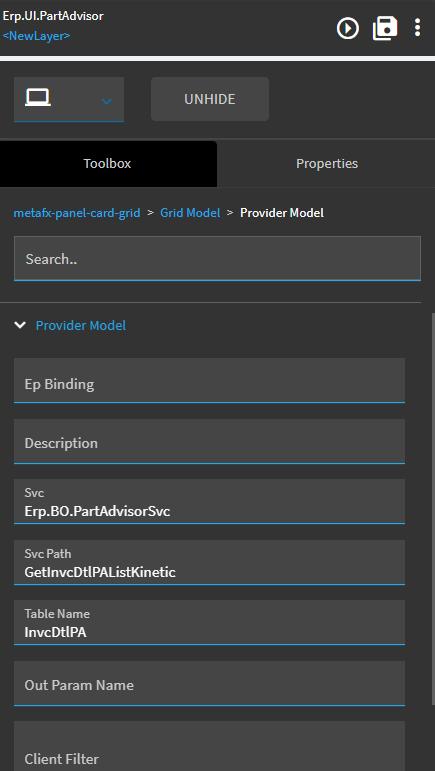
Looking at App Studio, Profitability in Part Advisor has an EpBinding of InvoiceView.
Provider is: Erp.BO.PartAdvisorSvc
Service: GetInvcDtlPAListKinetic
I have a manufactured part which also shows zero cost on the two most recent invoices. Both invoices are Posted, so I’m not sure if its waiting for those jobs to be closed to add the cost to the invoice? Not sure how that works.

1 Like
It looks like the binding to this panel is found here:
And the method of the PartAdvisorSvc is here:
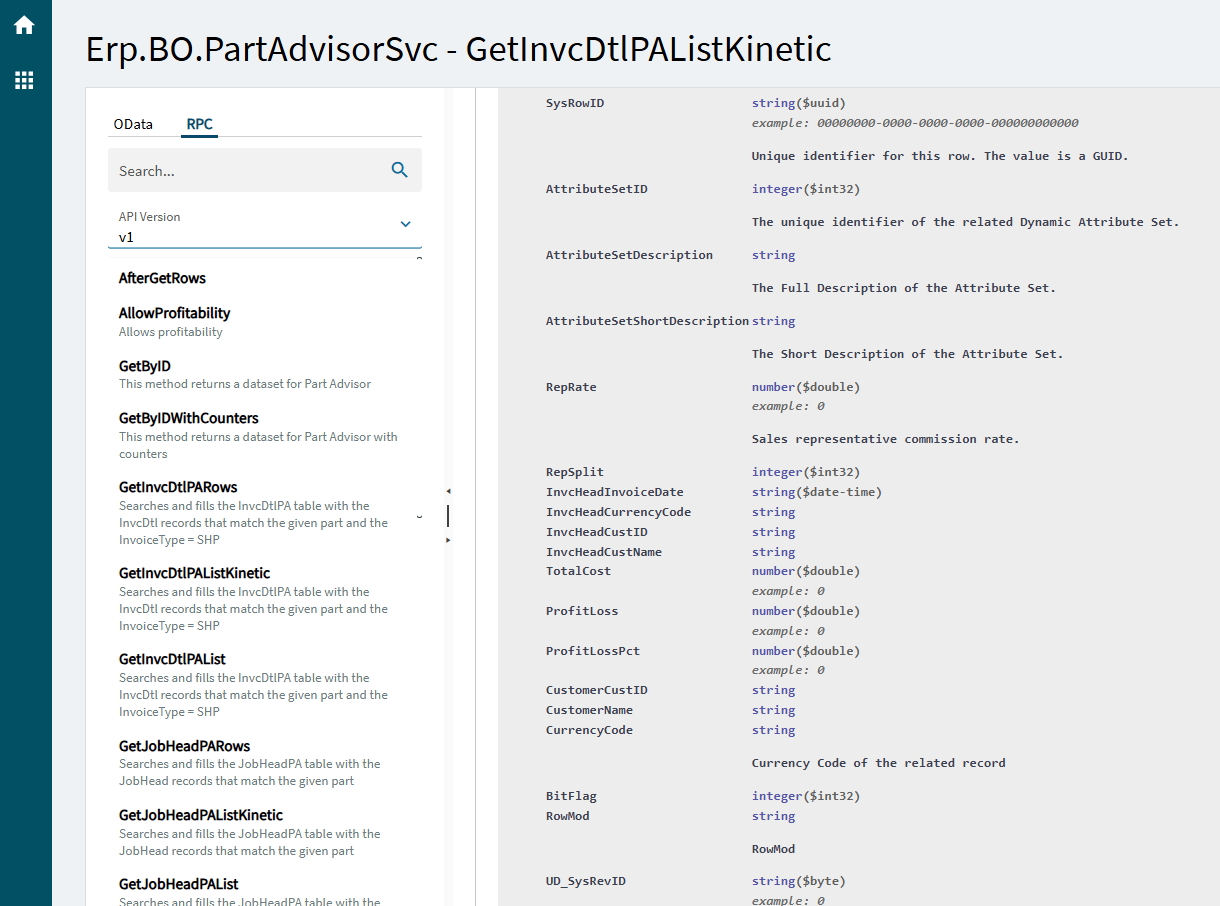
You could play with this output in REST to see the Erp.Tablesets.InvcDtlPARow records.
1 Like
I know average cost method can zero out prices if the inventory is shipped below zero. What is your cost method? As well if the job is received to inventory and then the parts are issued, this can mess up the average cost calculations. Best of luck!
2 Likes

1 Like
So, this is one of the reasons I personally do not like “last cost” because there are situations where the cost of the item might now be zero (you already wrote all the cost off to previous receipts)… In your case, you already said you had messy job splits and received these in multiple receipts. It could be simply that in the job splits and completions that all the costs were pushed to the split off jobs… and the final receipt that you did adjusted the durrent Last Cost to zero. This will affect any inventory already in stock. That means that you probably also have a writeoff for any inventory and its values.
Note that this is not a bug.. but it is behaving the way that last cost works. It at the point of receipt, it will change the last cost to the value of that receipt, and any active inventory is revalued.
This is why i am a proponet of Average cost or Standard cost (Unless you are Lot controlled, at which point Lot Costing is also an option). Average will account for this type of transaction in a better way.
- receive 10 at $5 each (total inventory 10 @ $50)
- Receive 15 at $6 each. Now your average is 5.6 each (total inventory of 15 @ $140)
- receive 5 at $0 each. In last cost this will adjust your total inventory from $140 to zero. but in Average cost, it stimply reduces the average to 4.5 which is more accurate that zero.you now have 20 units at $4.50 each for a total of $140 and no writeoff of the $140
6 Likes
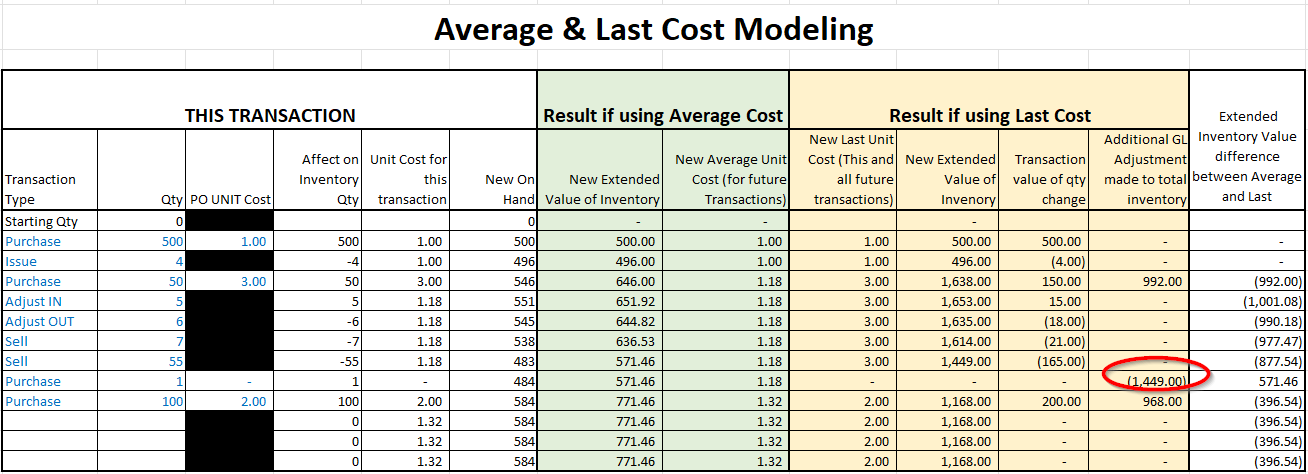
OK.. more information on this… I started to find my “Average cost model” spreadsheet that i use to explain this, but I got distracted… now i am back on it. Here is a simple spreadsheet example that compares the difference between transactions if they are AVERAGE vs if they were LAST cost.. some of what you see is based on some extreme examples. In this case, my initial purchase was for $1, and then I purchased more for $3… but between all that I also “purchased a sample unit for $0. For Average cost, if you look at the new average unit cost you will see that it changes, but only changes slowly over time. But then, look at the Last Cost.. you will see that when we received the $0 sample, it adjusted ALL the inventory that is currently in stock down to zero, causing a huge adjustment to stock value. This is why i dont like last cost. If you look at the last column in this spreadsheet, you can see the difference between the total inventory value at average vs last.
6 Likes
Thanks Tim!
1 Like
One other thing to watch out for with Last Cost is how quickly it can distort your inventory valuation. A new employee runs a job and takes twice as long as normal. That inflated cost flows into the job, and when the parts hit inventory, they become the new “last cost.”
The problem? Epicor applies that last cost to all existing inventory for that part. Suddenly, one high-cost transaction revalues everything you already had on hand.
That means:
- Inventory values spike (artificially inflating your balance sheet). This can also impact abc code breakdowns depending on timing
- Cost-plus pricing can increase unexpectedly.
- Financial reports look misleading compared to true operational performance.
1 Like
YIKES
An error occurred: Body seems unclear, is it a complete sentence?