I’d say being better matters more than being first/early:
VisiCalc - Spreadsheet
IBM Simon/BlackBerry - Mobile Phone
Tivo - Digital Video Recorder
Nokia 7650 - Camera Phone
Betamax - Video Tape Format (Being first AND better didn’t help!)
Netscape Navigator - Web Browser
Diamond Rio PMP300/Microsoft Zune - Portable Media Player
dBase/FoxPro/Clipper - Personal Database System
Wordstar/WordPerfect - Word Processing
Apple Lisa - Graphical User Interface
Microsoft Tablet PC - Tablet device ten years before the iPad
Atari - Video Game
Friendster - Social Network
Often times, especially in tech, the fast follower does better. Learning from others’ mistakes is a pretty decent strategy. For example, Apple is using Google Gemini for it’s AI. They haven’t gone into debt like the other AI players.
But for the sake of this thread, is there a technical reason that a company running their own version of Kinetic in Azure and not get the same benefits from AI?
Mark: From the technical side, there are competing AIs and if you get access to that AI service yes it can offer some comparable functionality. From what I have seen Epicor does not yet have a moat around a compelling AI offering.
So right now, I would say you can get comparable functionality by using other services or local platforms on-premises. I think the move by Epicor is more about the future they want to reveal and the course they want to take untethered by the on-premises offering.
AI is again quite wide in scope, and it currently describes many things, so any answer I give will be only partially accurate.
To me the best goal for AI, as I have mentioned, is Automation, in fact I kind of wish the term was “IA” not “AI” as in “Intelligent Automation” rather than “Artificial Intelligence”. The reason I prefer the former term is because I think it better describes the goal, in that, we want to Automate and delegate tasks to the machine that are considered more intelligent work, we do not want to fully relinquish control, just have it take on more tasks. This ultimately makes your workforce and business more efficient, so that is the return on investment.
The Epicor ERP software is about returning to you savings that offset the cost of the software, by allowing efficiencies that would otherwise not be possible.
AI should not be about a clever parlor trick in how cool it is to respond in a conversational way, it needs to be very concrete in how it saves your business money by making your workforce more productive, often by taking on mundane tasks, freeing up time for more value-added tasks.
I think to button up this discussion I will say that AI has some building block services and capabilities, but as with many things, you must tailor it for specific tasks, so you can get some services generically, but I expect Epicor intends to build more specific services that work out of the box on their software, and in specific segments of their customer’s needs. Services that would be cost prohibitive for an individual customer to build for themselves from scratch.
But again, it is up to Epicor to layout this compelling case, I am only talking about the potential. Peace.
David, I don’t disagree with you in principle. I agree that automation and orchestration is looking very promising for AI. We see this in the coding arena already. Also, adding a conversational interface to systems is well-suited to AI along with fuzzy searching using BERT-like vectorization.
Unless Epicor is training on our data, which I have not heard they were nor am I sure that some companies would be pleased with that, the only changes would be on Epicor’s codebase. Again, I don’t see why that could only happen with user databases in SaaS.
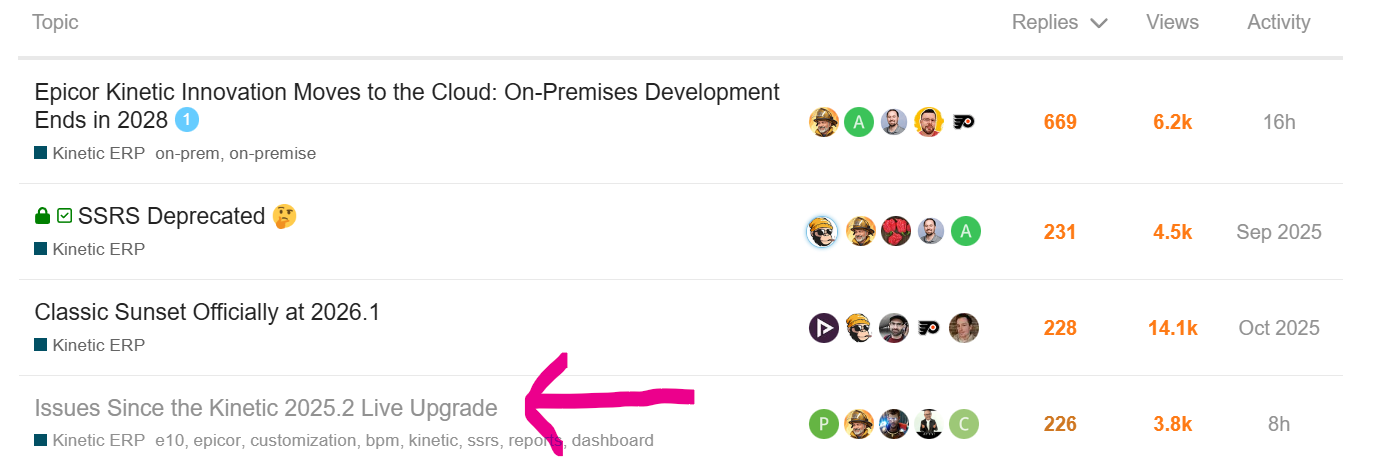
Does anyone know what the levels are required updates on Epicweb are? As off posting the 4th most replied topic on this board is how bad a SaaS upgrade just went. I would have though with Epicor announcing that they are forcing us to the cloud that they would make sure any SaaS updates went perfect.
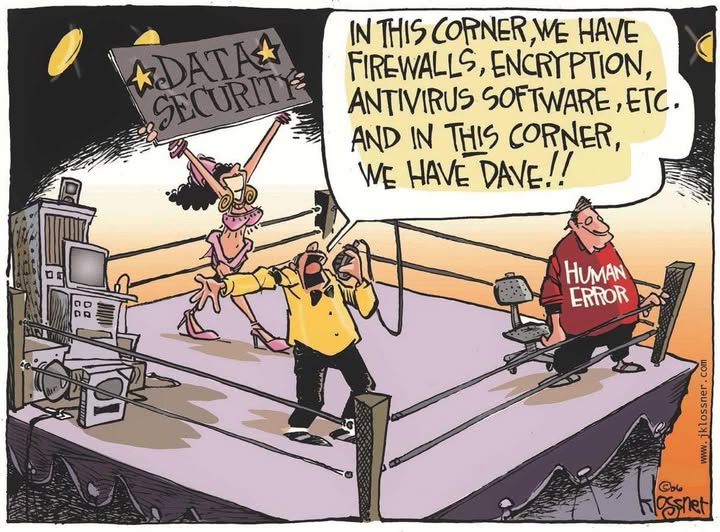
The myth that the cloud is secure while on-prem is not ignores a simple reality: security is about configuration, not location. You are only as safe as your most recent oversight, regardless of where your data sits. While the cloud offers modern tools, a legacy on-prem environment running Windows Server 2008 R2 can remain untouched for years if managed with discipline and proper hygiene. Ultimately, hardware isn’t the liability—complacency is.
This same logic explains why some industrial companies still run Windows XP today without incident. These machines aren’t “lucky”; they are strategically isolated. By air-gapping systems, using strict VLAN segmentation, and disabling all non-essential services, these organizations remove the entry points that modern automated threats rely on. They treat their infrastructure like a vault rather than a storefront, proving that even “obsolete” software is secure when the perimeter is impenetrable.
Beyond security, the control of on-premise infrastructure provides a massive operational advantage: speed. When an ERP system is hosted locally, your team has direct access to the metal, allowing you to diagnose and fix critical issues in seconds rather than waiting hours for a cloud provider’s support ticket or navigating a black-box service outage. In a high-stakes environment, having your hands on the steering wheel is often the most secure position to be in.
If your selling point is only security, you already lost me.
On-premise ERPs offer a distinct advantage for manufacturers by running natively on the LAN with zero latency and no reliance on an “always-on” internet connection. By keeping your operations local, you protect your PLCs and critical hardware from the risks of WAN exposure; attempting to secure industrial equipment over the open web often leads to misconfigurations that a simple, isolated LAN avoids entirely.
Lastly, if I want the cloud, I can self-host on AWS, Digitalocean, Vultr, Hertz, Azure. I am not saying it’s bad, it just doesn’t cure cancer, and its time to realize that it doesn’t.
Basecamp, Adobe, Geico, Dropbox among others are de-clouding or going Hybrid… They claim to save 80-300$ million, now they can invest that money in their business, perhaps innovate the next generation of their products, not give it to Microsoft or Amazon.
Dear Mfg Company Ask yourself; Did your competitor invest money in beating you, or gave it all to Microsoft Your Competitor will be in business another 50 years, you might be filing for Bankruptcy next year. If your costs go up, the price list of our product goes up – which allows the Competitor to win, some of us run on very competitive margins. In Automotive even a penny can get you declined on a General Motors Quote. If your product is shipped bad you now are on their sh*t list and no longer eligible for class A Quotes.
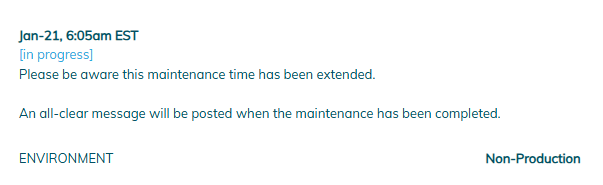
One of the things that is exceptionally frustrating for those of us who are SaaS (or implementing it) and I’d like to see resolved is the lack of clarity.
For instance the extension of maintenance AFTER it was supposed to be completed without ANY indication of when it will be completed.
I do understand that this is for a non-production maintenance which clearly takes a backseat to Production but we’re in the implementation phase and all work is currently done in pilot so this is literally halting any progress we’re making.
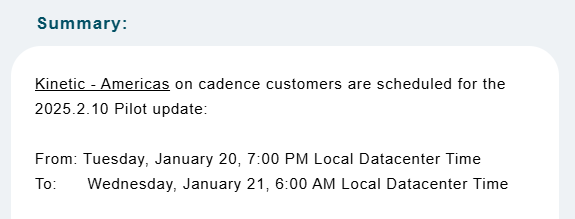
The above is EST, but the summary uses a Timezone I never heard of. Im surprised the upgrade takes that long in the cloud where it is all automated. It should be ~2 hours.
Am I the only one who has previously upgraded an Enterprise on-prem environment in under ~3 hours we’re talking 27 AppServers Loadbalanced with IE, Localization, 3 seperate instances etc…
Minor patches should NOT take the time they take, something is off here. Followed by an Extension hmm…
I don’t think we should normalize this. Pilot is my environment to test and learn, not Epicor.
One of the main purposes (to me) of the status page is for us to be able to plan ahead and be proactive when dealing with scheduled maintenance. Hard to do when they move the goal post after the game is supposed to be over.
I didn’t mean to suggest that the non-production environments aren’t important. I think they are critical, especially to us at the moment as we are in our implementation phase. My thought was that to the general population they aren’t as important as production. I would expect (and understand) in the instance that both production environments and non-production environments are down at the same time more resources would be given to get the production environments back up.
One reason is that people throw cloud around like it’s one thing. 37Signals closed most of its private datacenters too. 37Signals left the PUBLIC cloud. They are using a colocation service that does their HVAC, electrical, networking, etc. The “cloud” is way more than someone else’s computer; it’s the whole infrastructure.
The other reasons people are leaving the public cloud is they are running servers there! That’s way more expensive. Lift and shift is going to cost you a ton. Geico pissed away 50% first by not rearchitecting. Utilizing the cloud properly requires rearchitecting and there wasn’t time during the pandemic to do so.
Meanwhile, the non-profit Signal says they can’t afford NOT to run in the cloud. Why’s that?
One of the most private and secure systems in the world uses the public cloud. How can this be?
Meredith has a very good, but very different point about the hyperscalers that run the public cloud. It’s far too concentrated. That’s where people should be concerned.
I’ve had the computer room. Yeah, it’s fast. One bad fire or employee sabotage and you’re ____ed. How long did it take to buy servers and network equipment during the pandemic? How much to buy RAM for a new server today if water poured into the computer room? The hyperscalers and AI companies have all the RAM. Now what are you going to do?
Sitting on either extreme of all public cloud or all on-prem has a lot more risk than sitting somewhere inbetween.
Epicor for most customers runs fine on a Raspberry PI. We ran it on a Lenovo Laptop (yes that was our server, just dont close the lid) for a year w/ 32 users
But when you are as large as Amazon, Signal, then of course its a different beast.






 Your Competitor will be in business another 50 years, you might be filing for Bankruptcy next year. If your costs go up, the price list of our product goes up – which allows the Competitor to win, some of us run on very competitive margins. In Automotive even a penny can get you declined on a General Motors Quote. If your product is shipped bad you now are on their sh*t list and no longer eligible for class A Quotes.