Ok no  here.
here.
Let’s kick off what we learned, what we liked, what we didn’t, etc.
Just keep it civil and mostly serious 

Ok no here.
Let’s kick off what we learned, what we liked, what we didn’t, etc.
Just keep it civil and mostly serious
Quick outline

On Premise “upcoming” road map provided some relief to me (and some) though details are still sparse they are clearly working on some sort of bridge to fill the gap between full SaaS and Hybrid SaaS and the two sessions on it with leadership were informative.
The App Studio Prism Developer Agent approaches the “shut up and take my money” kind of feature, I’m sad it isn’t on prem (see above) but I am excited that it will make the VERY tedious work of working on App Studio much easier.
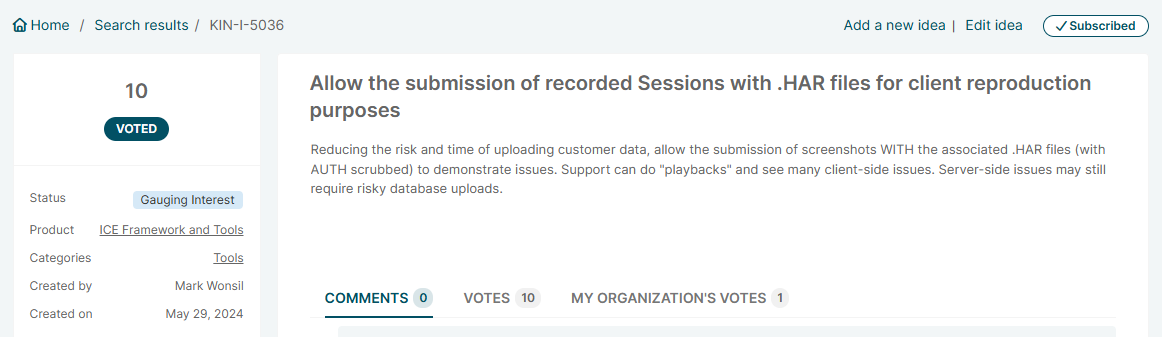
I went to the recoder presentation and lab at the very end of the conference. I was really excited about it after the first part where they explained the concept of how it worked, then when I went to the lab, got less excited about it. There are a bunch of settings and filters that you have to set to start using it appropriately, and getting it right is not very intuitive. There is definitely some refinement that could be done to make it more specific to Kinetic, as it captures all of the browser, and you have to know where to put the settings in to appropriately pare it down to what you need when you are doing what is essentially a trace. This really looks like a tool that a dev made for personal use, and never tidied it up for general use. Understandable, and that’s pretty much what I assume actually happened with the tool, but this hopefully is something that some team at epicor takes and makes more useable.
Then when trying to use the calls in postman, the collection is created, which is cool, but you still have to wire up all of the data set handling to pass states from one call to the next. So NOT automated at all. So more dev needed there.
It has a lot of potential for sure, but hasn’t really changed from what I can tell from when they first threw it out there to use. And now people like @GabeFranco and @josecgomez and probably others soon are going to make better tools that expand on the start of what this tool is doing for us.
Cool concept, and will be SUPER useful for automating workflows IF they can get some of the manual stuff that you have to do make it work done automatically, or at least a lot easier.
My main takeaways
 Automation studio team is finalizing details on usage based licensing (instead of # of connections)The Grow team is still working on Grow Data Platform. We should hear more by the end of the year. The new product is supposed to solve many of the issues we have with the current platform (security). There will be a migration path to the new platform.
Same with me. At the very least the free browser extension will be helpful for logging ticket with Epicor as it’ll have all the trace, step-by-step, and even a video of the issue.

It was nice to hear that they are working on something. In the end I’m optimist they will land on something that’s close to what we all want.
@timshuwy, was this Idea delivered?
Yes with Recoder you get that (or very close to that)
Below are my three key focus areas and takeaways from Insights:
Grids
Our group had a productive conversation with Epicor’s Dr. Aieat Assam regarding grid functionality. It was encouraging to feel heard, and we now have a concrete starting point for moving forward. I’m also optimistic that I may have identified the grid unicorn I was looking for.
Leveraging AI
The EpiUsers session, along with Deepak’s presentation, gave me a strong foundation for how we can begin incorporating AI more effectively within our local environment. There are some promising directions worth exploring further.
Bridging the Gap — Now to Future State
I presented a few ideas for how we can maintain productivity while we wait for the grid improvements to be fully realized. Epicor’s feedback was generally positive, though they noted that once custom tools are introduced, reverting to out-of-the-box functionality can become complex. That is a fair concern — but the priority right now is keeping operations moving.
I didn’t think it was a technology problem. It’s a policy change for the Support Team. Right? Will they only accept ReCoder traces or will Playwright traces work as well?
Or Microsoft.  I’m not trying to
  on ReCoder, but Selenium is losing mindshare for testing dynamic apps using Angular, Vue, and React frameworks. API testing is built into Playwright, so you can test the API and bail before wasting time on your UI tests. No Postman required.
This is good to hear. If it takes 2-3 years for a company to migrate to a new ERP system…

What was the AI presentation like? I missed insights this year (hopefully going next year ) and would love to see the presentation somehow.
They had a guy on stage say he did it in 2 weeks 
Yes, I heard. Did he upgrade from a non-Epicor product to Kinetic? They must have had some settled business processes!
They didn’t say he did it by choice, in fact they were forced to do it because they messed up and didn’t understand their contract from their old software. (I believe it was netsuite @Mark_Wonsil) They also said that they don’t recommend it. So can and should are two very different things. And just because the system is up, doesn’t mean your business is running in a healthy way.
It was my first Insights and I did get to see a bunch of different ideas and modules/features. Learnt alot, got Epicor support to fix some things right on the spot. Really valuable for my team who spent a lot of time in different labs.
From the perspective of being the person who would have to do the implementation, I would have loved to see a different type of session. The ‘How the heck would you implement this’ session.
I went to the Advanced Requisition Management (ARM) lab and got to use the feature which was really interesting and was a good display of how it works. Do you manually create all your parts, does it import everything from your existing database, like what do you physically have to do to get ARM up and running. From that i think i could get a better understanding of not just the value it can bring once you use it, but now the time-cost and effort of implementation.
Another thing was the EKW, scanning barcodes for information, picking/shipping etc. In this one I would have loved to see a 10 minute video of it in practical use. Here’s a shipping office employee creating a pick-list and then that gets assigned to a forklift device as a task, the forklift driver sees which bin the product is in, drives there scans it to say he picked it up, loads it on a truck, once he’s done he hits complete or something and shipping sees this as a complete load.
Again, very interesting to see these things, but i’m left with more questions than answers, left with little idea how this would work practically speaking for the front-line employees. To see a start to finish example scenario…even in a basic scenario…would leave me much more informed and able to build a vision around to actively pursue an implementation.
@bderuvo had at least one of those! And it was great! But yes more would be better.